Can Hair Loss Be Reversed? What Science Actually Shows
 LifeRxCategoryHair LossUpdated12 min read
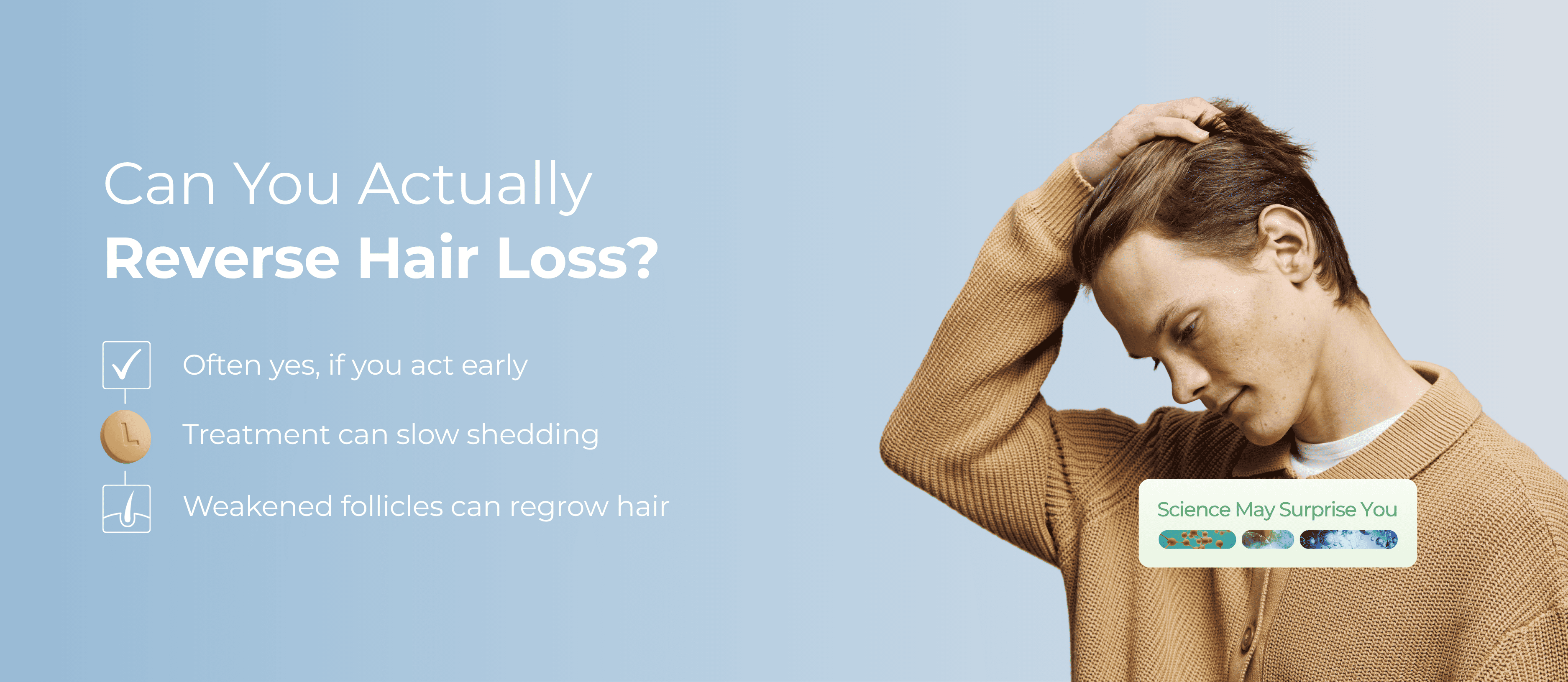
Short answer: It depends on the type of hair loss. Shedding caused by a temporary trigger, such as illness, childbirth, or chemotherapy, usually grows back once the trigger passes. Pattern hair loss, the most common type, works differently. Treatment can slow it and, for some people, thicken thinning hair, but it rarely restores everything that was lost, and results last only while treatment continues. Scarring hair loss is permanent. Starting early gives treatment more hair to work with [1][2][3].
Hair loss is not one condition. A person shedding after a stressful illness and a person with a slowly receding hairline are dealing with different problems, and the science gives them different answers.
This guide explains what "reversed" can mean, which types of hair loss tend to regrow, what treatment can realistically do for pattern hair loss, how long results take, and the safety points worth knowing before you start.
What "Reversed" Can Mean
People use the word to describe four different outcomes:
- Regrown. Hair returns after a temporary cause passes.
- Stabilized. Further loss slows or stops.
- Thickened. Thinning hair grows back thicker, or some hair returns in thinning areas.
- Restored. Hair returns to what it was before. This is rare in pattern hair loss.
Which outcome is realistic depends on the type of hair loss.
Which Types of Hair Loss Can Reverse?
The first question is whether the follicle is damaged. Nonscarring hair loss is reversible, and scarring hair loss, in which follicles are destroyed and replaced by scar tissue, is permanent [2].
| Type | Can it reverse? | What the research says |
|---|---|---|
| Shedding after a trigger (illness, surgery, childbirth, some medicines) | Usually yes | It typically starts 3 to 5 months after the trigger, is usually self-limited, and resolves within 2 to 6 months. It can last years if the stress continues [2]. |
| Chemotherapy-related shedding | Usually yes | Regrowth typically begins 1 to 3 months after the drug is stopped, and permanent loss is rare [2]. |
| Alopecia areata (sudden patches) | Often, but unpredictably | There is a high rate of spontaneous remission, but it can come and go [2]. For severe cases, three oral JAK inhibitors are FDA-approved [4]. |
| Pattern hair loss (androgenetic alopecia) | Partly | Treatment can slow it, and some people regrow hair, but it rarely returns to what it was and needs ongoing treatment [1][2][3]. |
| Medical or nutritional causes (thyroid disease, iron deficiency, malnutrition) | Often improves when treated | These can mimic pattern hair loss, so treating the cause comes first [2]. |
| Scarring alopecias | No | The hair loss is permanent, and absent follicle openings are a clue. Prompt evaluation matters [2]. |
Pattern Hair Loss: What the Science Shows
Pattern hair loss is genetically influenced. In people who are predisposed, follicles shrink over time (miniaturization), producing thinner, shorter hairs [3]. The FDA has approved two treatments: topical minoxidil and, for men, oral finasteride [3].
Finasteride (men)
In two trials of 1,553 men aged 18 to 41, finasteride 1 mg daily produced about 107 more hairs than placebo after 1 year and 138 more after 2 years in a one-inch circle of balding crown, where men started with about 876 hairs. The placebo group kept losing hair [5]. The American Academy of Dermatology (AAD) says finasteride finasteride has been shown to slow further loss in about 80% to 90% of men taking it, and that the men who tend to see the best results start soon after noticing hair loss [1].
Minoxidil
Over-the-counter 5% minoxidil for men is labeled for thinning at the top of the scalp, not for a receding hairline [6]. Regrowth is stronger at the crown than at the front [2].
What the evidence cannot promise
- Both medicines work better at prevention than regrowth. They stimulate regrowth in some men but are more effective at preventing progression [2]. Using both together often gives better outcomes than either alone [3].
- Results last only while you treat. Hair loss recurs when treatment is stopped [2].
- Advanced loss is less studied. The finasteride trials enrolled men with mild to moderate, not complete, hair loss, and the label states that efficacy in bitemporal recession (the corners of the hairline) has not been established [7].
- Women have different options. Topical minoxidil is the FDA-approved choice. Finasteride is not approved for women and is contraindicated in women who could become pregnant, and spironolactone is often prescribed off-label [3][2].
How long results take
These time frames come from different studies, so treat them as ranges, not a schedule:
| What | Time frame |
|---|---|
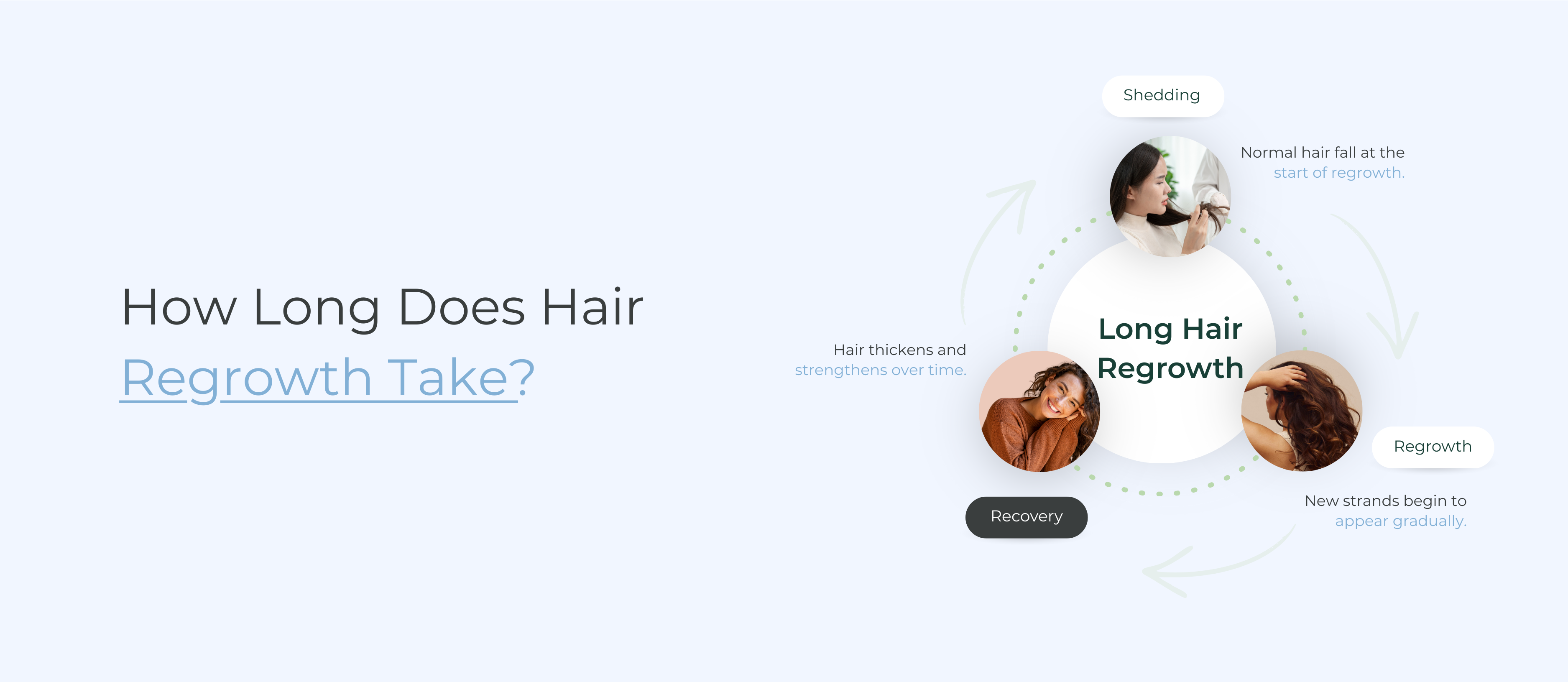
| Shedding after a trigger | Usually settles in 2 to 6 months [2] |
| Minoxidil: early shedding | Hair loss may temporarily increase after starting [3] |
| Minoxidil: first signs | About 2 months for some people, at least 4 months for others [6] |
| Minoxidil: check-in | At 4 months, the label says to stop use and ask a doctor if there is no regrowth [6] |
| Noticeable improvement | At least 4 to 6 months of consistent use [3] |
| Full effect | Minoxidil regrowth improves over 6 to 12 months [2]. The finasteride trials measured results at 1 and 2 years [5]. |
| After stopping | Hair loss recurs [2] |
The practical read: expect first changes at 2 to 4 months at the earliest, plan a check-in with a provider at about 4 months, and allow 6 to 12 months before judging how well treatment works. The 4-month label rule is a reason to talk with a provider, not a final verdict.
Other Options
- Platelet-rich plasma (PRP). A meta-analysis of 43 randomized trials (1,877 participants) found PRP improved hair density compared with placebo (mean difference 28.4 hairs per square centimeter, 95% CI 12.8 to 44.0), but did not significantly affect hair thickness. Results varied widely between trials because of differences in study design and incomplete reporting of how PRP was prepared [8]. PRP is typically used alongside established treatments, not on its own [3].
- Hair transplant. Surgery moves existing follicles and needs enough donor hair, typically more than 40 follicular units per square centimeter. It is generally considered for advanced cases where medical treatment hasn't worked [3]. Because pattern hair loss is progressive, ask any surgeon how they would plan around the hair you still have.
- Supplements and home remedies. A review of hair loss treatments noted that there is not good evidence to support the many other treatments listed in various texts [2]. If you want to try a supplement, talk to your provider first.
Safety to Know Before You Start
Every treatment has trade-offs. Your provider and the product label are the final word for your situation.
Over-the-counter minoxidil
Unless noted, these points come from the product label [6]:
- Don't use it if your hair loss is sudden or patchy, you don't know the reason for it, you have no family history of hair loss, you use other medicines on your scalp, your scalp is red, inflamed, infected, irritated, or painful, or you are under 18.
- The men's 5% product is for men only. Women should use a product labeled for women. If you are pregnant or breastfeeding, ask a health professional first.
- It is flammable. Keep it away from fire, flame, and smoking during and right after application.
- Stop use and ask a doctor if you have chest pain, rapid heartbeat, faintness, dizziness, sudden unexplained weight gain, swelling of the hands or feet, scalp irritation or redness, or unwanted facial hair growth.
Oral minoxidil is sometimes prescribed off-label and is not FDA-approved for hair loss [3]. Because it acts throughout the body, it requires a provider's oversight.
Finasteride 1 mg (men only)
- Who should not take it. It is for men only and is not for women or children. Women who are pregnant or could become pregnant should not handle crushed or broken tablets, because the drug can harm a male fetus [7].
- Mood. The US label lists depression and suicidal ideation and behavior among adverse reactions [7]. UK regulators advise stopping finasteride 1 mg immediately and contacting a doctor if depression or suicidal thoughts develop [9]. If you ever have thoughts of harming yourself, call or text 988 (in the US) or go to the nearest emergency room.
- Sexual effects. Reduced libido, erectile dysfunction, and decreased ejaculate volume can occur. These usually improve with time, but UK regulators warn that sexual side effects may persist after stopping treatment [3][9].
- Other label items. Breast tenderness or enlargement and male breast cancer appear among reported adverse reactions, so tell your provider about any breast lumps, pain, or nipple discharge. The label also advises caution if you have liver problems [7].
- Prostate screening. Finasteride can mask PSA levels, and StatPearls lists an increased risk of high-grade prostate cancer attributed to masked PSA and delayed detection. Tell any clinician who orders prostate cancer screening that you take it [3].
Other medicines your provider may mention
- Dutasteride is used off-label and is not FDA-approved for hair loss. Its side-effect profile is similar to finasteride's [3].
- Spironolactone (off-label, mainly in women) commonly causes menstrual irregularities, dizziness or headache, facial hair growth, rash, and high blood potassium. Tell your provider if you are pregnant, trying to conceive, or breastfeeding [3].
- Topical or compounded finasteride is not FDA-approved in any form. In April 2025, the FDA warned that compounded topical finasteride products lack FDA-approved labeling and reported 32 adverse event cases from 2019 to 2024, including erectile dysfunction, anxiety, suicidal ideation, depression, and decreased libido, most of which persisted after stopping. The FDA also noted these products lack the protective coating of tablets, which raises the risk of absorption by others, including pregnant women [10].
- JAK inhibitors for severe alopecia areata are specialist treatments. Relapse after stopping is common, and they carry monitoring requirements because of potential adverse effects [4].
When to See a Provider
A diagnosis comes first, because the right treatment depends on the type. Book an evaluation if:
- Shedding is sudden, heavy, or patchy
- Your scalp itches, burns, hurts, or looks red or scaly
- Hair loss followed an illness, surgery, childbirth, or a new medicine
- You are losing hair along with fatigue or unexplained weight changes
- You are under 18, pregnant, trying to conceive, or breastfeeding
- You have heart, kidney, or liver disease, or a history of depression
- Your thinning is gradual, runs in your family, and you want to know your options
Treatment is a choice. The AAD notes you don't need to treat male pattern hair loss, and the benefits last only while you keep treating it [1].
Frequently Asked Questions
Can hair loss be reversed naturally?
Shedding from a temporary trigger often resolves on its own as the trigger passes [2]. For pattern hair loss, a review noted there is not good evidence to support treatments beyond minoxidil and finasteride [2]. Because sudden hair loss can have medical causes, get evaluated instead of guessing.
Can a receding hairline grow back?
It is the hardest area to treat. Over-the-counter minoxidil is not intended for a receding hairline, and finasteride's efficacy in bitemporal recession has not been established [6][7]. A provider can help set realistic goals.
Can bald spots regrow?
It depends on the cause. Alopecia areata patches often regrow on their own, scarring hair loss is permanent, and in pattern hair loss, evidence for regrowth in areas of complete baldness is limited [2][7].
How long does it take to see results?
Plan on a check-in at about 4 months and allow 6 to 12 months for the full effect of minoxidil [6][2].
Will my hair loss come back if I stop treatment?
For pattern hair loss, yes. Hair loss recurs when treatment is discontinued [2].
Is female hair loss reversible?
Often, depending on the cause. Shedding after childbirth or illness usually resolves [2]. For female pattern hair loss, topical minoxidil is the FDA-approved option, and a provider can check for mimics such as thyroid disease or iron deficiency [3][2].
The Bottom Line
Whether hair loss can be reversed depends on the type. Temporary shedding usually regrows once the trigger passes. Pattern hair loss can be slowed and sometimes thickened, but rarely restored, and the benefit lasts only while you treat it. Scarring hair loss does not regrow. That makes the first step a diagnosis, not a purchase.
If you want to take that step, LifeRx.md offers an online hair loss consultation. You complete an intake about your symptoms and medical history, and a licensed provider in your state reviews it. If the provider determines treatment is appropriate, they recommend a plan that may include a prescription. A consultation doesn't guarantee a prescription, and the provider decides what is right for you. Learn more about LifeRx.md hair loss care, or read what causes hair loss in men and how treatment works.
This article is for educational purposes and is not a substitute for medical advice, diagnosis, or treatment.
References
- American Academy of Dermatology. What is male pattern hair loss, and can it be treated? https://www.aad.org/public/diseases/hair-loss/treatment/male-pattern-hair-loss-treatment
- Phillips TG, Slomiany WP, Allison R. Hair Loss: Common Causes and Treatment. American Family Physician. 2017;96(6):371-378. https://www.aafp.org/afp/2017/0915/p371
- Ho CH, Sood T, Zito PM. Androgenetic Alopecia. StatPearls. Updated January 7, 2024. https://www.ncbi.nlm.nih.gov/books/NBK430924/
- Baricitinib, Ritlecitinib, and Deuruxolitinib Demonstrate Efficacy in Severe AA. Practical Dermatology. https://practicaldermatology.com/news/baricitinib-ritlecitinib-and-deuruxolitinib-demonstrate-efficacy-in-severe-aa/2485957/
- Kaufman KD, Olsen EA, Whiting D, et al. Finasteride in the treatment of men with androgenetic alopecia. Journal of the American Academy of Dermatology. 1998;39(4):578-589. https://www.jaad.org/article/S0190-9622(98)70007-6/abstract
- Men's Rogaine Extra Strength (minoxidil 5% solution), drug label. DailyMed, National Library of Medicine. https://dailymed.nlm.nih.gov/dailymed/drugInfo.cfm?setid=ccaecec5-5348-4b24-9190-5464c50f6d80
- PROPECIA (finasteride) tablets, prescribing information. U.S. Food and Drug Administration. https://www.accessdata.fda.gov/drugsatfda_docs/label/2022/020788s030lbl.pdf
- Platelet-Rich Plasma in the Management of Alopecia: A Systematic Review and Meta-Analysis of Clinical Evidence. Dermatology and Therapy. 2025. https://pmc.ncbi.nlm.nih.gov/articles/PMC12550094
- Medicines and Healthcare products Regulatory Agency. Drug Safety Update, April 2024: finasteride and the risk of psychiatric and sexual side effects. https://assets.publishing.service.gov.uk/media/6630a6d03579e7a8f398a9a6/April_DSU.pdf
- FDA warns of potential risks with compounded topical finasteride products (FDA alert of April 22, 2025, as reported by Healio). https://www.healio.com/news/dermatology/20250422/fda-warns-of-potential-risks-with-compounded-topical-finasteride-products