
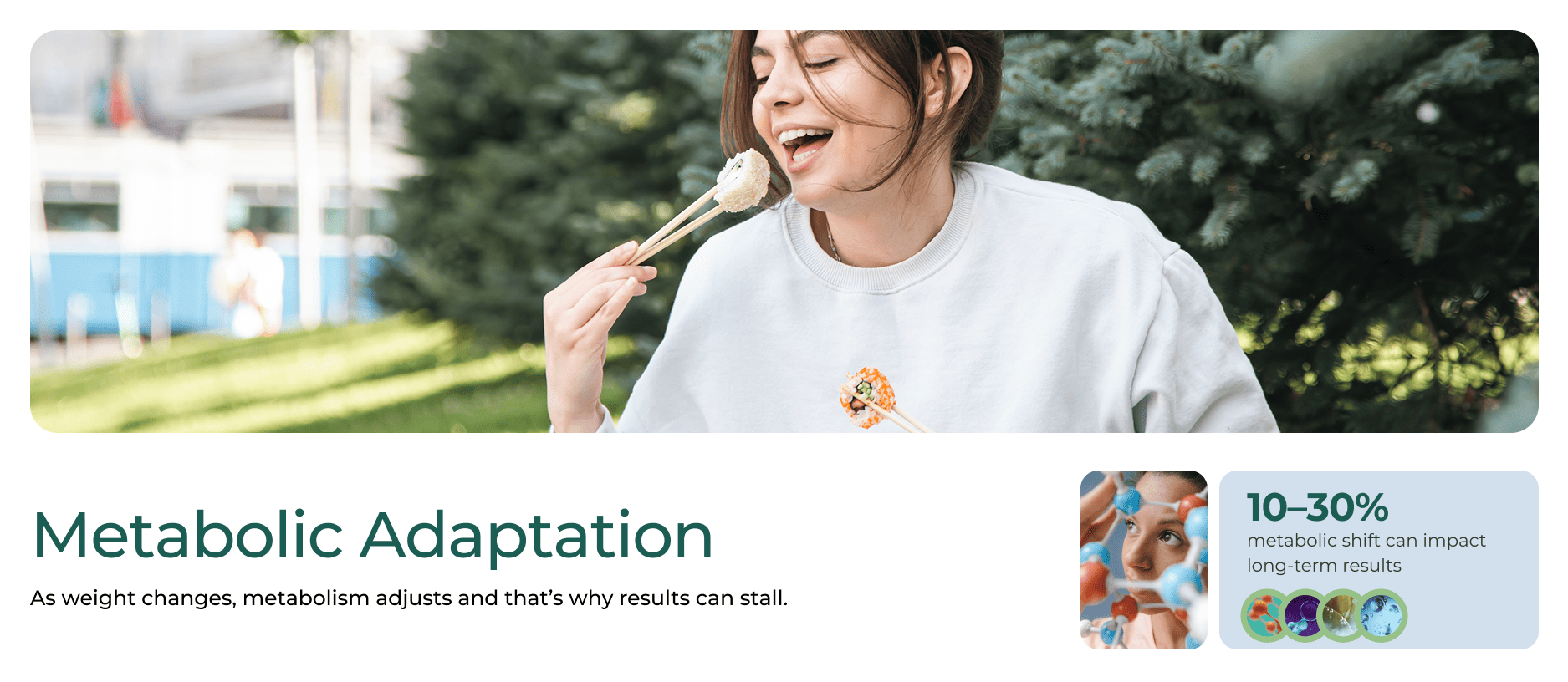
Short answer: When you lose weight, your body burns fewer calories than before. Some of that is simply because you are smaller. Metabolic adaptation is the extra drop beyond what...
Short answer: When you lose weight, your body burns fewer calories than before. Some of that is simply because you are smaller. Metabolic adaptation is the extra drop beyond what your new size would explain. It is real, but studies suggest it is often small and varies from person to person. It is also only one reason progress slows. Hunger tends to rise, some lean tissue is lost along with fat, and it gets harder to keep up the same effort. A slowdown is a normal body response, not a sign you are doing something wrong [1][2].
If your weight dropped steadily for the first few months and then slowed, you are in good company. Most people who lose weight reach a stretch where the scale moves more slowly, and it can feel like your body is working against you.
In part, it is. But "metabolic adaptation" gets blamed for more than the evidence supports. This guide explains what it is, how large the effect really is, what else slows progress, what can help, and what to bring up with a clinician.
What Metabolic Adaptation Means
Your body burns calories to keep you alive and moving. After weight loss, two things lower that number:
- You are smaller. A smaller body burns less. Across studies, total calorie burn falls by roughly 20 to 30 calories per day for each kilogram lost, or about 9 to 14 per pound [2].
- Metabolic adaptation. Your body burns even less than a person of your new size and body composition would be expected to burn. This extra drop is called metabolic adaptation, or adaptive thermogenesis [1].
Researchers are still working out why it happens and how much it matters in everyday weight management [1].
How Big Is the Effect?
Some websites claim large drops in metabolic rate. The research is more mixed:
- Most studies find some effect, but better-designed studies find less. A systematic review of 33 studies (2,528 adults) found adaptation in 27 of them. Better-designed studies reported small or non-significant effects, and the effect lessened or disappeared once weight stabilized. Measurement methods vary a lot between studies [1].
- Calorie burn is only part of the story. In a model of a typical lifestyle program, calorie burn at the weight plateau was less than 200 calories per day lower, while appetite had risen by 400 to 600 calories per day [2].
- The famous case is an outlier. Contestants on "The Biggest Loser" lost about 58 kg on average over 30 weeks of extreme dieting and exercise, and were still burning about 500 calories per day less than predicted 6 years later [3]. That makes them a poor guide for most people.
Why Progress Slows Over Time
Metabolic adaptation is one piece. The others often matter as much or more. Unless noted, these points come from Hall and Kahan [2]:
- A smaller body needs less energy. The calorie gap that worked at the start shrinks as you lose weight, even if nothing else changes.
- Appetite rises. For each kilogram lost, appetite increases by about 100 calories per day above baseline, several times the fall in calorie burn. Modeling suggests appetite plays a larger role than slowing metabolism in explaining plateaus. In one study that followed people for a year after weight loss, leptin, ghrelin, and other appetite-related hormones had not returned to their earlier levels, and hunger remained higher [4].
- Some of the loss is lean tissue. In typical diet-induced weight loss, about one-quarter of the weight lost is fat-free mass, although the share varies widely [5]. Less lean tissue means a lower resting calorie burn.
- Effort fades. In lifestyle programs, weight typically falls for several months and then levels off, often within the first year, as keeping up the same effort gets harder.
What the timeline often looks like
These time frames come from different studies with different people, so treat them as ranges, not a schedule:
| Phase | What the research shows |
|---|---|
| First several months of a lifestyle program | Weight typically falls, then levels off, often within the first year [2] |
| After weight stabilizes | Studies find adaptation lessens or disappears [1] |
| About 1 year | Appetite-related hormones were still altered in one study [4] |
| 6 years (extreme case) | A gap of about 500 calories per day persisted in Biggest Loser contestants [3] |
Plateau, Adaptation, or Something Else?
Before assuming adaptation, check the other explanations:
- Day-to-day noise. Weight fluctuates, so look at the trend over several weeks, not a single weigh-in.
- Gradual calorie creep. Rising appetite can push intake up without you noticing.
- A change in body composition. In a meta-analysis, adding resistance exercise to a diet didn't change total weight, but it shifted the loss toward more fat and less lean tissue [6].
- Medicines. Ask your clinician whether any of your medicines could affect your weight. Never stop a prescribed medicine on your own.
- Health conditions. Ask for an evaluation if you are gaining weight without a change in habits, or have new symptoms such as marked fatigue, cold intolerance, irregular periods, swelling, or shortness of breath.
What Helps
The research does not describe a proven way to "reset" metabolism, but a few habits support progress:
- Strength training. In a systematic review, resistance exercise during dieting protected against loss of fat-free mass (moderate certainty), increased fat loss (high certainty), and improved strength (low certainty) [6].
- Checking your protein. Ask your clinician how much protein is right for you, especially if you have kidney disease.
- A careful approach to cutting further. Rising appetite makes deeper restriction hard to sustain. Talk with a clinician before cutting calories again.
GLP-1 Treatment and Plateaus
Plateaus can happen on prescribed GLP-1 treatment too:
- Appetite feedback is weaker, not gone. Modeling of clinical trial data suggests GLP-1 treatment and bariatric surgery weaken the appetite feedback response by roughly 40% to 70%, which lets weight loss continue longer before leveling off. Calorie burn still falls as weight drops [7].
- Lean mass deserves attention. In a 2026 systematic review of studies with at least 10% weight loss, fat-free mass made up about 31.5% of the weight lost with GLP-1-class (incretin-based) therapies, compared with 14.3% for diet and exercise and 32.9% for bariatric surgery. These are comparisons across separate studies, not head-to-head trials, and the authors point to structured exercise as a way to protect lean mass [8].
- A plateau is a conversation, not a reason to act alone. If progress slows on treatment, talk with your prescribing clinician before changing your dose or stopping. Treatment decisions are individual, and not everyone is a candidate.
When to See a Provider
Reach out if:
- Progress has stalled for several weeks despite consistent effort
- You are gaining weight without a change in habits
- You have new symptoms, such as marked fatigue, cold intolerance, irregular periods, or swelling
- You notice you are losing strength or muscle
- You are on prescribed treatment and have persistent vomiting, signs of dehydration, or dizziness
Questions Worth Bringing to a Visit
- What does my weight trend look like over the past several weeks, and is it truly flat?
- Could any of my medicines or health conditions be affecting my progress?
- Am I getting enough protein, and should I add strength training?
- How is my sleep, and is it worth addressing?
- If I'm on treatment, what should I expect from here, and when should we reassess?
Frequently Asked Questions
What is metabolic adaptation in simple terms?
It is a drop in calorie burn after weight loss that is larger than your smaller body would predict. In most studies it is modest, and it differs from person to person [1].
Is it "starvation mode" or metabolic damage?
Those terms overstate it. In the research, adaptation varies between people and tends to lessen once weight stabilizes, which is different from permanent damage [1]. Extreme programs such as The Biggest Loser may differ [3].
How long does metabolic adaptation last?
It depends. A systematic review found it lessened or disappeared once weight stabilized [1], while an extreme program showed a persistent gap at 6 years [3]. Appetite changes can last longer than the calorie-burn effect [4].
Can metabolic adaptation be reversed?
The research does not describe a proven reset. Adaptation tends to lessen once weight stabilizes [1], and strength training helps protect lean tissue during weight loss [6].
Should I cut calories further to break through a plateau?
Not automatically. Appetite rises as you lose weight, which makes deeper restriction hard to sustain [2]. Talk with a clinician first, since medicines, sleep, or muscle loss may also be playing a role.
Does a plateau mean my plan has stopped working?
Not necessarily. Plateaus are common, and a smaller body, higher appetite, and lean mass loss all contribute [2][5]. A clinician can help you work out which factors apply to you.
The Bottom Line
Metabolic adaptation is real, but it is often smaller than the headlines suggest, and it is only one reason progress slows. A smaller body, rising appetite, lean mass loss, and the difficulty of sustaining effort all play a part. The most useful responses are practical: protect your muscle, stay patient at a plateau, and check for other causes before cutting calories further.
If you want medical support, LifeRx.md offers an online weight management consultation for $49. Insurance is not required, and there are no membership fees, contracts, or ongoing commitments. A licensed provider reviews your health history, required lab work is completed before starting treatment when it applies, and the provider decides whether a prescribed treatment is appropriate. A consultation does not guarantee a prescription. You can also read about what a GLP-1 program involves.
This article is for educational purposes and is not a substitute for medical advice, diagnosis, or treatment.
References
- Nunes CL, Casanova N, Francisco R, et al. Does adaptive thermogenesis occur after weight loss in adults? A systematic review. British Journal of Nutrition. 2022. https://www.cambridge.org/core/journals/british-journal-of-nutrition/article/does-adaptive-thermogenesis-occur-after-weight-loss-in-adults-a-systematic-review/726FC60518DA67349B9C3EC1D75A7156
- Hall KD, Kahan S. Maintenance of lost weight and long-term management of obesity. Medical Clinics of North America. 2018;102(1):183-197. https://pmc.ncbi.nlm.nih.gov/articles/PMC5764193
- Fothergill E, Guo J, Howard L, et al. Persistent metabolic adaptation 6 years after "The Biggest Loser" competition. Obesity. 2016. https://onlinelibrary.wiley.com/doi/full/10.1002/oby.21538
- Sumithran P, Prendergast LA, Delbridge E, et al. Long-term persistence of hormonal adaptations to weight loss. New England Journal of Medicine. 2011. https://www.nejm.org/doi/full/10.1056/NEJMoa1105816
- Heymsfield SB, Gonzalez MCC, Shen W, Redman L, Thomas D. Weight loss composition is one-fourth fat-free mass: a critical review and critique of this widely cited rule. Obesity Reviews. 2014;15(4):310-321. https://pmc.ncbi.nlm.nih.gov/articles/PMC3970209/
- Effect of resistance exercise on body composition, muscle strength and cardiometabolic health during dietary weight loss in people living with overweight or obesity: a systematic review and meta-analysis. PubMed (PMID 40909191). https://pubmed.ncbi.nlm.nih.gov/40909191/
- Hall KD. Physiology of the weight-loss plateau in response to diet restriction, GLP-1 receptor agonism, and bariatric surgery. Obesity. 2024. https://onlinelibrary.wiley.com/doi/10.1002/oby.24027
- Busk-Cirera et al. Effects of incretin-based therapies, diet and exercise interventions, and bariatric surgery on fat-free mass in adults with overweight or obesity: a systematic review and meta-analysis. Diabetes, Obesity and Metabolism. 2026. https://pmc.ncbi.nlm.nih.gov/articles/PMC13449088/